“On
Easter Monday, 24 April 1916, at a time when Ireland was an integral part of
the United Kingdom of Great Britain and Ireland, seven Irishmen proclaimed the
establishment of the Irish Republic, nominating themselves as its provisional
government. Together with 1,600 poorly armed followers, they occupied a number
of prominent buildings near the centre of Dublin, the General Post Office in
Sackville Street (now O’Connell Street) being designated as headquarters. The
government of Great Britain and Ireland regarded the insurrection as treason,
all the more reprehensible as it came in a critical phase of the war then being
waged with Germany and her allies.” From The 1916 Rising: Personalities &
Perspectives, an online exhibition – National Library of Ireland 2006
This event was known as the Easter Rising. The
fighting continued throughout the week and resulted in more than 400 deaths, over 2,000 injuries, and the destruction of many parts of Dublin,. The
seven co-signers of the proclamation and eight other insurgents were tried and executed
by firing squad.
During Easter week, fighting took place predominantly
in Dublin, but lesser skirmishes were reported throughout Ireland. On April 25,
Easter Tuesday, the Irish Volunteers in Galway destroyed the railway line
between Galway and Oranmore, cut telegraph wires, and attacked the Police Barricks in Clarenbridge. On the morning of April 26, one
police constable was killed when the Irish Volunteers fought the RIC (Royal Irish Constabulary) at the
Carnmore crossroads. The Volunteers
retreated to Moyde Castle near Athenry and remained at the castle until April
29, when a large force of police and military arrived nearby.
The volunteers, although strong in numbers, but poorly armed, realized their
defeat and dispersed.
Most of the Volunteers were arrested the following
week and eventually deported to Frongoch
Internment Camp in South Wales. The rank-and-file were detained until August
while the more prominent members of the Irish Volunteers were not released
until December 1916. Three hundred and twenty-two
Irish Volunteers from County Galway were arrested for their part in the Easter
week risings.
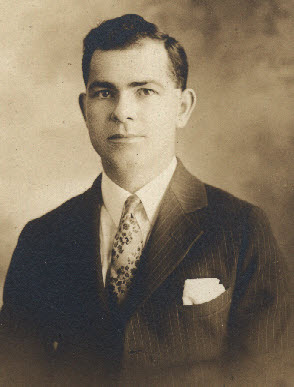
William Joseph Quinn II wrote that he took part in
the Easter week risings with Kinvara Company, County Galway; rendering
service from April 24, 1916 to April 27, 1916.
His unit was listed as Kinvara Co. Galway Irish Volunteers and his
commanding officers were Thomas McInerney and John “Jack” Burke. His service
was rendered in Kinvara, Ballinderreen, and the Gort district in County
Galway. He was involved in seizure of
arms, fired on the police patrol and was with the company on Ballindereen Road,
on the way to Moyde, when the company was ordered disbanded. On the pension
application, he stated that the following men could attest to his service during Easter week:
John Burke, Cahermore,
Kinvara, County Galway
Thomas
McInerney, Cahermore, Kinvara, County Galway
Padraic Fahey,
Tullyra, Adrahan, County Galway
In 1953, William Quinn wrote, “was arrested on May 3rd and taken to Galway Jail from there I was
removed to Richmond Barricks in Dublin from there I was removed to Wandsworth
Jail in London and later was sent to Frongoch internment camp in North
Wales. Was released in September 1916.
To verify this I think I was the only William Quinn in the camp if you see the
first book of the Irish Rebellion you will find my name there with Kinvara Co. My
address then was Caheravoneen Kinvara Co Galway.”
William Quinn was found on a list of prisoners
arrested and taken to the Galway Jail on May 3, 1916. All other prisoners
listed on ledger page with William Quinn were from Kinvara. William was described as 22 years old, 5 feet
8 ¾ inches tall, and weighed 160 pounds.
He had black hair, hazel eyes, and a fresh complexion. It was written that he was a farmer, was
single, Roman Catholic, and could read and write. His offence was written as
“Defence of the Realm Act* Sinn Feiner” and it was stated that he was handed
over to the military on June 5, 1916. No
trial date was listed, but “3” (assuming 3 months) was written under the column titled “On Remand.”
According to his pension application, William Quinn
was active with the Irish Volunteers, Kinvara Company in 1916 following his release from Frongoch Internment
Camp.
In 1953, when awarded his pension, William Quinn was awarded the 1916 Medal for his active service during the week commencing April 23, 1919 with the Kinvara Company of the Irish Volunteers.
*The Defence of the Realm Act (DORA) passed in 1914 gave the government extensive powers during the war period. It was used
to requisition buildings or land, make regulations creating criminal offences,
censor journalism, and even reduce the strength of beer and restrict pub hours
in order to reduce drunkenness among war workers.
Sources:
Fergus Campbell, Land and revolution: nationalist
politics in the west of Ireland, 1891–1921 (Oxford, 2005).
Timothy G. McMahon (Editor), Pádraig Ó Fathaigh's
War of Independence: Recollections of a Galway Gaelic Leaguer, Irish Narrative
Series (Cork University Press 2000)
Next – The Irish Uprising: 1917 to 1919
Diana
© 2011, copyright Diana Quinn